
MobiWork provides software solutions for the management of SIM cards in Machine-to-Machine, and Internet of Things systems. Our software dashboard enables operators to manage their fleet of installed devices through a single view of all SIMs, structured across multiple companies, departments and sites.
MobiWork develops and licenses high-availability software for use in the Telecommunications Industry.

Software is hosted in our data centre and customers gain access to a rich set of functionality at highly competitive rates enabled by the SaaS model.

Products and services provide tools for network operators and M2M service providers to manage their fleet of deployed M2M and IoT devices.
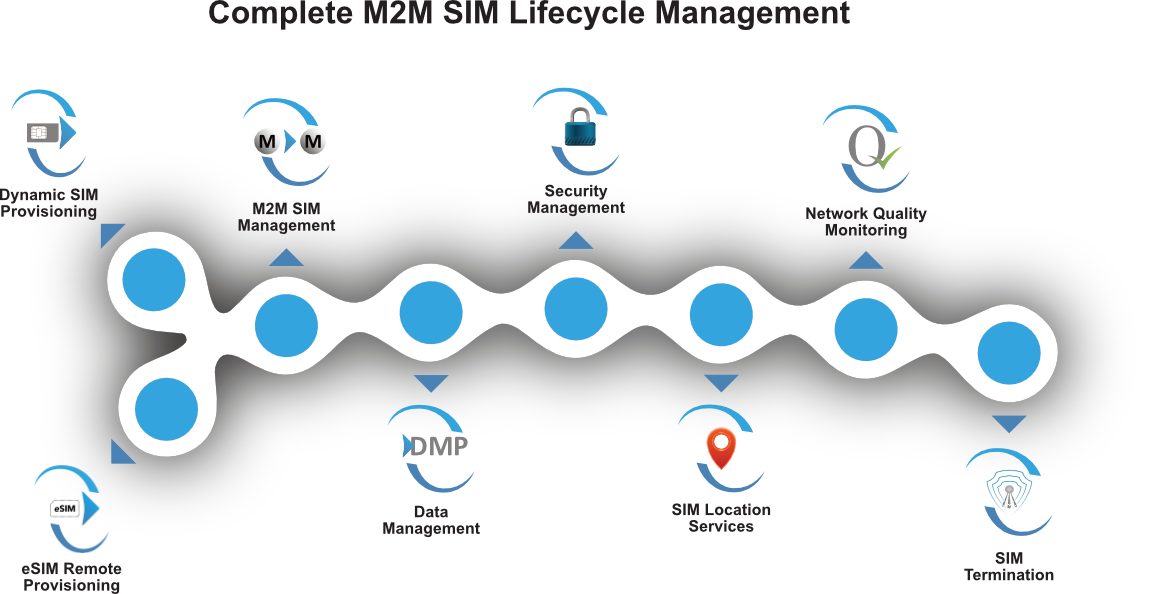
The Dynamic SIM Provisioning (DSP) platform offers real-time activation of the SIM card on the mobile network, and is able to provision any network node with the relevant subscription information. It includes functionality enabling the subscriber to select their MSISDN, and an OTA component to update the IMSI on the SIM if required.
The eSIM Remote Provisioning system enables the management of the mobile subscription on the M2M eSIM. It includes the SM-DP and SM-SR and all related components for full remote provisioning of eSIM cards.
The M2M SIM Management Platform provides the user with a single view of the status of their deployed SIM cards, and the ability to manage the SIMs from the Graphical User Interface. It enables fine-grained control to the Mobile Network Operator and the M2M Service Provider, of every aspect of their SIMs and the services deployed on the SIMs.
The Data Management Platform enables fine-grained management of data allocation and usage for each M2M SIM. The platform provides a view of the data used by the SIM in its current period, and the data remaining until the end of the period. From the dashboard the user can open the Data Management user interface to setup data quotas and usage alerts per SIM, or disconnect the SIM from the data network.
The Security Management system provides an end-to-end security layer for M2M solutions. A security API is loaded onto the SIM, and the M2M device can use this to encrypt sensitive information before sending it out. Tools are also provided for the decryption of the data at the backend.
The SIM Location system provides several services related to the location of the SIM and device. It locks the device to a region, ensuring that the device cannot be used outside the intended region. In addition, it interfaces with a tracking system to provide real-time and historical location information on the device.
The Quality of Service system captures network quality events experienced by the device, and records the data on the server for analysis and reporting.
As M2M grows, the number of SIMs in devices grows. Inevitably, some of those devices are left on, while the accompanying M2M service is terminated – e.g. vehicle tracking, home alarm system. Eventually, the network subscription associated with the SIM is suspended, and then terminated, which “orphans” the SIM. Network shield protects the network against the unwanted traffic generated by orphan SIMs.
The Secure OTP (S-OTP) system protects an OTP sent to the subscriber via SMS, by encrypting it, and requiring a PIN before the decrypted OTP is displayed to the user. This is a user-friendly, yet powerful mechanism of combating SIM swop fraud.
14 May 2019
SIM swop fraud occurs when the SIM card registered against a user’s mobile network account is swopped for another SIM that is not in the possession of the legitimate user, and without the consent of the legitimate user. The Secure OTP service implements a user-friendly solution to secure the OTP, and it thereby eliminates the largest driver of SIM swop fraud. Read more…
28 February 2019
A SIM card in an M2M device can be hard to reach, and can remain in the device long after the mobile network service has been canceled. Even after the corresponding network account has been deleted, such a SIM will continue to attempt to authenticate and communicate on the network, generating unwanted traffic on the network. This is a growing problem for Mobile Network Operators as M2M and IoT proliferate. Read more…